Portugal receives tens of thousands of exchange students a year and Lisbon takes the largest share of them. That popularity is most of the appeal, you will not struggle to find people in the same position as you, and it is also the reason the accommodation is difficult.
The single most useful thing in this guide: start looking eight weeks before you arrive, not two. Everything else is detail.
The calendar you are competing against
Portuguese universities run two semesters. The first starts in mid-September and runs to early February, with exams in January. The second starts in mid-February and runs to late June or July.
The housing market moves ahead of both. The crunch for September arrivals begins in July, and the rooms nearest the campuses are gone first. For February arrivals the crunch is late December and early January, which is worse because it collides with everyone travelling for the holidays.
If you are arriving in September, you want your room settled by early August. If you are arriving in February, settle it before you go home for Christmas.
What the universities do and do not provide
This is where a lot of incoming students lose a month. Portuguese public universities have residences, but the number of beds is small relative to demand and priority normally goes to students on financial support. Exchange students are usually well down the list, and the application windows are early and strict.
Assume you are finding your own accommodation. If a residence place comes through, excellent, but do not build your plan on it, and do not turn down a confirmed room in July on the hope of a residence place in September.
The international offices are genuinely helpful with paperwork and orientation, and mostly unable to help with housing beyond pointing you at listings.
Why the normal rental market will not work for you
The ordinary Lisbon rental market asks for a Portuguese guarantor, a fiador who becomes liable for your rent, plus a Portuguese tax number, a local bank account, two or three months of deposit and a twelve-month lease.
As an exchange student you can satisfy none of those. You are here for five months, you have no Portuguese guarantor, and you cannot open a local bank account before you arrive. This is not a matter of being organised; the standard route is structurally closed to you.
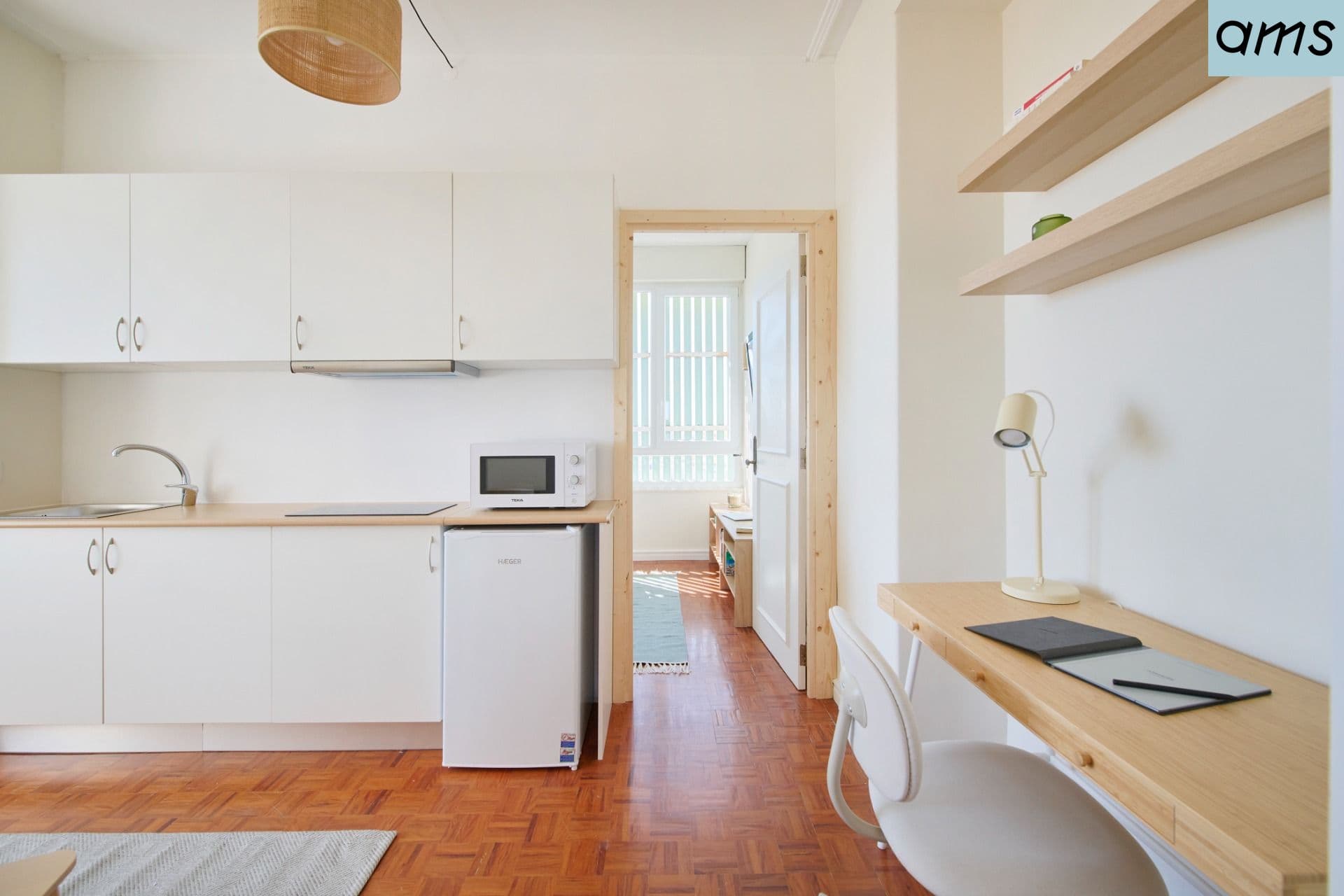
What works instead is room rentals and coliving, where the operator holds the head lease and the requirements are lighter. With AMS specifically there is no guarantor, no Portuguese bank account and semester-length contracts, which exists precisely because the standard route does not fit this situation.
Where to live, by university
Lisbon's campuses are scattered, so the right neighbourhood depends entirely on where you are enrolled. The commute is the thing that will define your semester.
| Instituto Superior Técnico | Alameda or Arroios, both a 10–15 minute walk |
|---|---|
| ISCTE | Saldanha, Campo Pequeno or Alvalade |
| NOVA (Campolide) | Marquês de Pombal, Parque or Saldanha |
| NOVA FCSH | Saldanha, Avenida or Marquês de Pombal |
| Católica | Saldanha, Marquês de Pombal or Alvalade |
| ISEG | Santos or Cais do Sodré |
| UAL | Avenida or Marquês de Pombal |
| IPL | Alto dos Moinhos |
The paperwork, in the order that works
EU students need very little: your EHIC for healthcare, your ID, and a registration certificate at the local câmara if you stay beyond three months. Non-EU students need a student visa arranged before travelling and a residence permit appointment afterwards.
Everyone will eventually want a NIF, the Portuguese tax number, and most people want a local bank account. Neither is needed to book a room with us, which matters because both are much easier to obtain once you already have a Lisbon address.
The order that actually works: accommodation, then arrive, then NIF, then bank account, then everything else.
A month-by-month timeline for a September start
The single biggest predictor of how well an Erasmus semester starts is how early the accommodation was settled. This is roughly the sequence that works.
| May–June | Nomination confirmed. Apply for university residence if there is one, but do not plan around it. |
|---|---|
| Early July | Start looking seriously. Decide the neighbourhood from your campus, not from photographs. |
| Late July / early August | Book the room. This is the point at which the good options near campus disappear. |
| August | Non-EU: visa appointment. Everyone: start the NIF if you can do it remotely. |
| Early September | Arrive a week before classes. SIM card, Navegante pass, NIF if not already done. |
| First fortnight | Bank account, university registration, and the social calendar that will define the semester. |
What a semester costs
Budget roughly €800–1,000 a month all-in if you are sharing a room and cooking most meals, and €1,100–1,500 if you have a private room and eat out a few times a week.
Rooms with us start at €440 a month with water, electricity, gas and wifi included, which removes the most common budgeting mistake, an advertised price with utilities on top is typically €70–110 more than it looks in winter.
The €40 Navegante transport pass covers the entire city, and student discounts apply on much else. Lisbon remains one of the cheaper Erasmus destinations in western Europe, if not the bargain it was ten years ago.