Almost everything written about Lisbon's neighbourhoods is written for visitors. That guidance is close to useless if you are moving here, because the things that make a neighbourhood a good place to visit (being in the middle of the old town, being surrounded by restaurants, being near the nightlife) are often precisely the things that make it a difficult place to live.
What actually matters over a year is duller and more decisive: how long it takes to get to where you go every day, whether you can sleep, what it costs, and whether there is a supermarket.
Start with the commute, not the atmosphere
This is the part people get backwards. They pick the neighbourhood that felt best on a weekend visit and then discover they are making a forty-minute journey twice a day, five days a week, around 130 hours a year, which is three working weeks spent underground.
Work out where you will physically be most days. If you are at Instituto Superior Técnico, that is Alameda, and the neighbourhoods that work are Alameda and Arroios. If you are at ISCTE, it is Saldanha, Campo Pequeno or Alvalade. If you are at ISEG, it is Santos or Cais do Sodré. Everything else is a compromise you will feel every morning.
Then decide how much noise you can live with
Lisbon's centre is loud in a way that is genuinely charming for a weekend and genuinely difficult on a Tuesday night before an exam. Cais do Sodré's Pink Street runs until dawn. Bairro Alto is a bar in every building. Parts of Santos and Arroios get busy at weekends.
Against that, Alvalade, Parque, Campo Pequeno and Alto dos Moinhos are properly quiet residential districts where the loudest thing on a weeknight is a moped. They are less exciting and you will sleep.
The honest version: if you are twenty-one and here for a semester, take the noise. If you are working full-time or writing a thesis, do not.
The price gap is real, and smaller than you think
Across our own 421 rooms the median is €675 a month with bills included, and the range runs from €440 to €1,750. The cheapest neighbourhoods by median are Alto dos Moinhos, then Alameda and Saldanha; the most expensive tend to be Santos, Marquês de Pombal and the riverside, largely because that is where the studios are.
What is worth noticing is that the gap between the cheapest and the most expensive room, as opposed to a studio, is a couple of hundred euros a month. That is real money, but it is less than the difference a good commute makes to your life. Do not optimise the wrong variable.
The short version, neighbourhood by neighbourhood
Every one of these is on the metro, which is the baseline we work to. The full guides go into transport, walk times and what is currently available.
| Alameda | The student heartland. IST on top of it, two metro lines under it, cheap food. Busy, unpretentious, the best value near a campus. |
|---|---|
| Saldanha | The business district. Two metro lines, everything walkable, an airport train. Practical rather than beautiful. |
| Marquês de Pombal | Top of Avenida da Liberdade, park behind you, three lines. Grown-up and central. Most of the studios are here. |
| Arroios | The most international parish in the city. Best food, good value, walkable to IST. |
| Alvalade | Planned, residential, tree-lined and quiet. The move for people who have had enough of sleeping above a bar. |
| Santos | Design studios and the river. Creative, sociable, walkable to ISEG. |
| Cais do Sodré | River, trains, ferries and the loudest nightlife in Lisbon. Unbeatable connections, questionable sleep. |
| Avenida | The grand boulevard. The centre on foot, theatres and kiosks, UAL above it. |
| Parque | Quiet streets beside the biggest park in central Lisbon, minutes from Saldanha. |
| Campo Pequeno | Between the business district and residential Lisbon, fifteen minutes' walk from ISCTE. |
| Alto dos Moinhos | Green, calm, next to IPL, and the lowest prices we have anywhere. |
Questions worth asking before you take a room
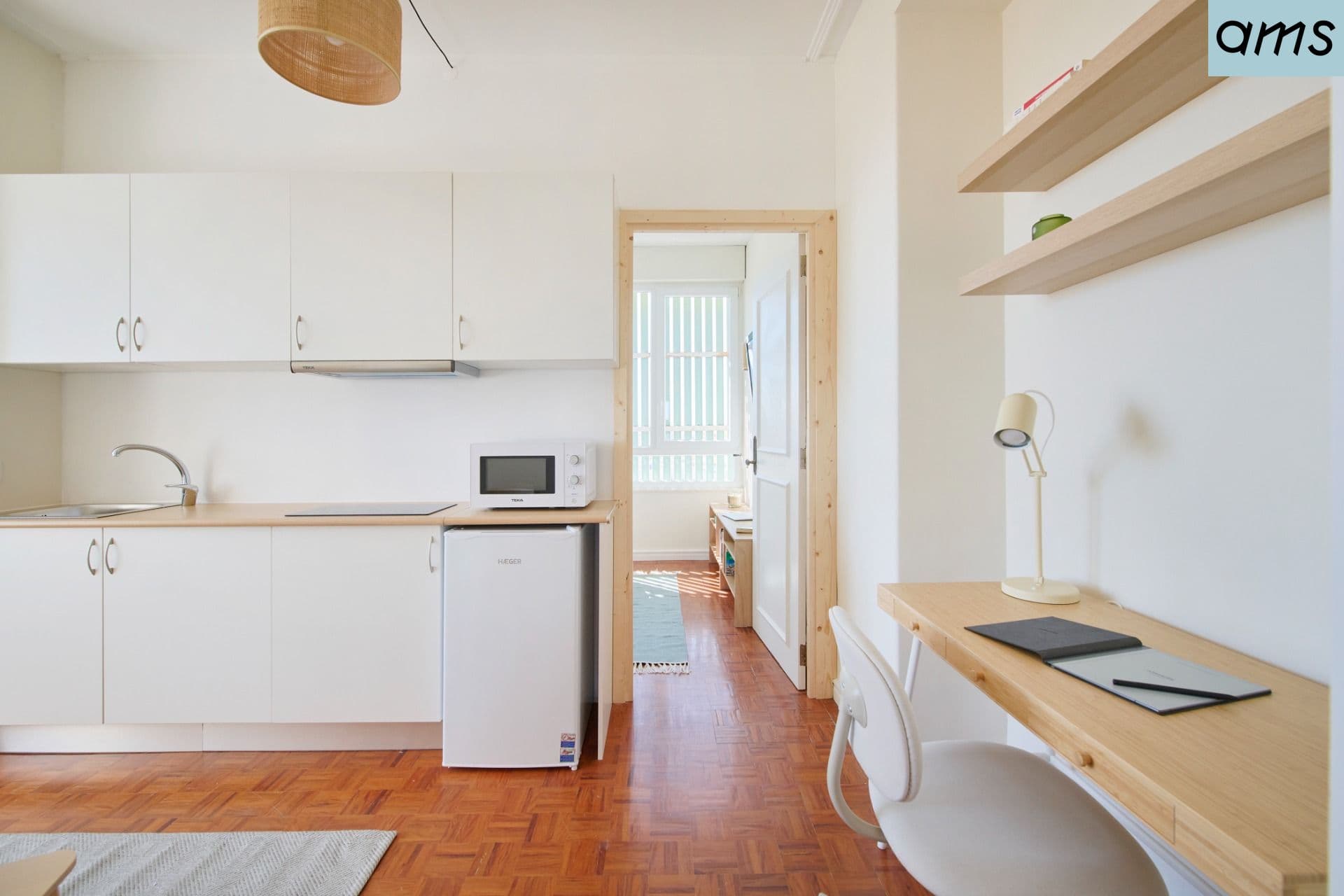
Photographs tell you about the furniture and nothing about the things that will actually shape your year. A short list of questions separates a good room from an expensive mistake, and most of them are things a landlord will answer honestly if asked directly.
- Which way does the room face, and does it get direct sun? Interior rooms are cheaper and darker, and in a Lisbon winter that matters more than you expect.
- Is there heating, and of what kind? Most Portuguese housing has none, and January indoors is the thing new arrivals most often underestimate.
- How far uphill is it from the metro? Ask for the walking route, not the distance.
- What is the street like at 2am on a Saturday? Some of Lisbon's prettiest streets are directly above bars.
- Is there a supermarket within five minutes? In the older quarters, sometimes there genuinely is not.
- What is included in the price, exactly? An advertised rent with utilities on top runs €70–110 higher in winter.
The mistake almost everyone makes
Signing a twelve-month lease on a neighbourhood you have never lived in. You cannot tell from a visit whether a street is noisy at 2am on a Thursday, whether the supermarket is any good, or whether the walk up the hill from the metro is going to wear on you.
The sensible play is to start somewhere flexible and central, spend a couple of months actually living in the city, and then commit. That is a large part of why coliving exists here: it lets you be wrong about the neighbourhood without it costing you a year.